

It’s a damp October day, but I’m well insulated in army surplus and I’ve eaten my daily quota of garlic. It’s time to head up to Plantation Wood, quite a funky place with many native trees and some weird ones, such as the magnificent Redwood (Wellingtonia) with its spongy red trunk soaring up to the heavens.
AMETHYST DECIEVER
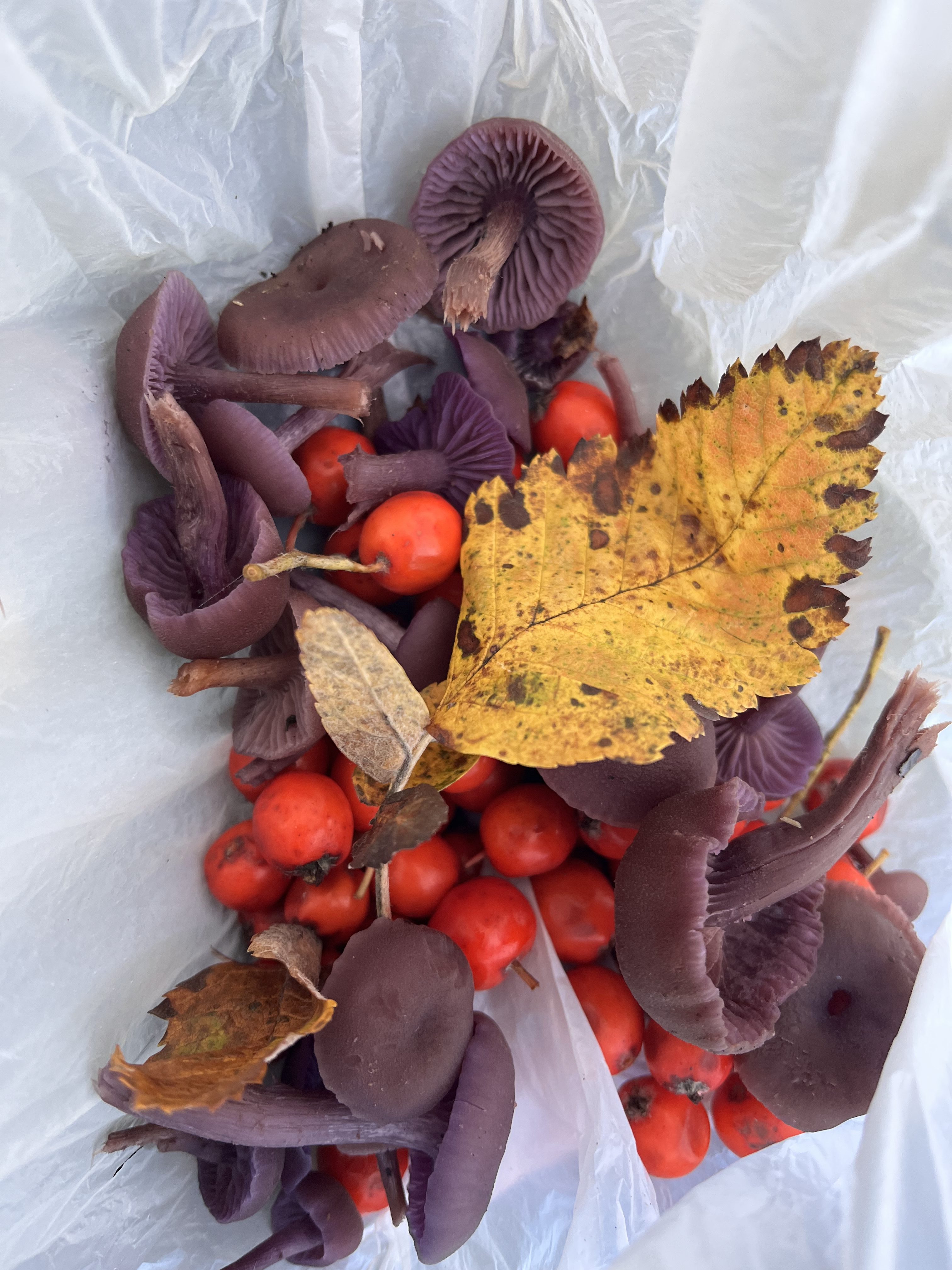
In the damp Beech leaf litter I spy old favourite Amethyst Deceiver (Laccaria amethystina). They are small, but once you see one and ‘get your eye in’ as Phil said, you’ll see many more.

Amethyst Decievers have a texture like Jelly Babies, as do their close relatives, Deceivers (amber-coloured and equally edible). The stem is fibrous. The gills are thick and widely spaced. The spore print is white to lilac.
Notice the cute ‘umblicus’ in the middle of the cap – like a belly button!

I enjoy Amethyst Deceivers in omelettes, soups and stews.
FALSE DEATH CAP
Now we meet the False Death Cap (Amanita citrina). This beautiful fungi belongs to the great and terrible Amanita family, which includes the deadly Death Cap (A. phalloides) and Destroying Angel (A.virosa)

False Death Cap isn’t actually poisonous, it is technically edible. It tastes nasty and bitter, however, and is best admired but not eaten. (Assuming the fact it grows out of a volva and resembles a lethal cousin hasn’t put you off already.)
Notice the crusty flat scales on the cap. This distinguishes A.citrina from the deadly Amanitas. It smells of celery and has white spores. It grows under both deciduous and evergreen trees, as long as the soil is acidic and not too damp. It has a pretty glowing sheen to it.
HOOF FUNGUS
THe Hoof Fungus is named because…well, you have a guess and you’ll probably guess right! Fomes fomentarius is a very common woodland fungi. Not edible, but very useful to Neolithic peoples, who used it as a tinder fungus.

In my photo above, you can see both the whole Hoof fungus, and a portion of the interior that’s been processed into a tinder and fire-lighting tool. This layer sits just under the gills and needs to be extracted with a sharp knife. After a lengthly period of boiling and pounding flat, your ‘mushroom leather’ will hold an ember that sparks onto it.
If you can be bothered.
CHARCOAL BURNER & COMMON YELLOW RUSSULAS
The delicious Charcoal Burner (Russula cyanoxantha) and the Common Yellow Russula (R. ochroleuca) can both be found in this wood.

Russulas are a great fungi family to know as they contain some great edibles, plus there’s a really fun way to identify them – Snap, Peel, Sniff, Taste! I don’t recommend this for ANY other fungi families, but with Russulas we can follow some simple steps.
Russulas have friable flesh. This means it crumbles easily, like chalk. In most species you can peel off the cuticle, the thin skin that covers the cap. Poisonous Russulas are not deadly, but they will make your digestive system sad! Most are distinguished by a peppery smell and taste.
The Common Yellow Russula is edible but not great. The Charcoal Burner has a delicious crunchy taste of hazelnuts!


As you see, the flattened cap resembles the colours charcoal goes when it burns. The stipe (stalk) is thick, and the flesh is firm. It doesn’t break as easily as some of the other Russulas.
MAZEGILL
Mazegill (Daedalea quercina) is a bracket fungus. It grows on dead stumps and logs, but sometimes fruits on chestnut trees. It’s inedible, with a texture like rock, but look underneath at the gills and your’e in for a treat.

The underside is a labyrinth rather than gills…great fun for your finger to try and find its way through! You can find Mazegill all year round as it’s so dry as to be virtually indestructible.
FUNGI I.D.Field Courses
If you’d like to come on a Fungi identification field course, dates all through October are coming up, plus one on the 7th of November.
Book from my Field Courses page – either click the Field Courses heading on my main page, or click on the link below. Click on the cross by Know Your Fungi. More details can be found there.
See you in the wilderness…
xx Hedgewitch Kat xx
2 responses to “Meet The Mushrooms of Plantation Wood”
[…] Meet The Mushrooms of Plantation Wood […]
Thanks, author of Garden Journal! Where are you based?