
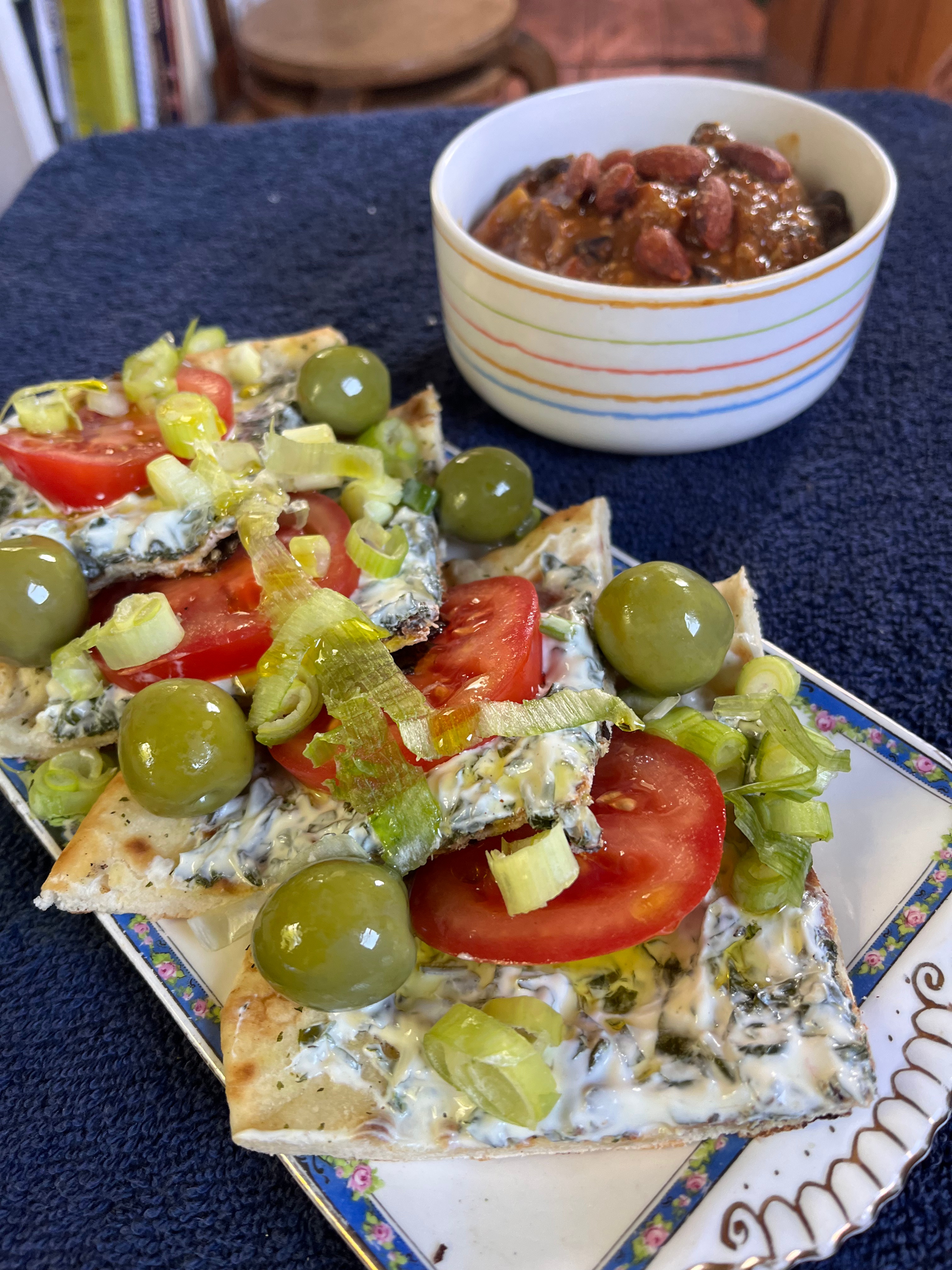
This week, I’m going to show you how I make a delicious peppery, fermented spread/dip from Hedge Mustard (Sisymbrium officinale). No, it’s not the same plant as ‘Garlic Mustard’, which is Allaria petiolata!!
This recipe for ‘Hwerneh’, hails from Palestine, where every Winter and early Spring the climate becomes wet enough for this Brassica (Cabbage) family member to grow in profusion.

Identifying Hedge Mustard (Sisymbrium officinale)
Here’s how to identify the plant we’ll be using this week (or whenever you have time or inclination…)
Where in the world does it grow?
Hedge Mustard is native to the UK, Europe, Macronesia, Central Asia, Palestine, and W. & N. Iran, and N. Africa, Russia, Switzerland and Finland, and many more.
It’s introduced into the US, South America, Siberia, Japan…for the exhaustive list (and it is exhausting) visit this link at Kew Online. So basically, wherever you are in the world, apart from Antarctica, you’re likely not far from a source of tasty veggie condiment.
Find Hedge Mustard in Spring (in temperate zones) at the edge of paths and waysides, or in disturbed soil.

Hedge Mustard I.D.
Below is a mature Hedge Mustard plant. It grows to around 90cm, though personally speaking the ones I see in he UK rarely get above 50cm as they like to grow on verges and disturbed ground and end up getting trodden on/given a ‘haircut’!

Hedge Mustard Flowers
Brassica family members have 4-petalled flowers. You can see from the picture below, Hedge Mustard flowers are small (3mm across) and yellow with 4 petals. They are arranged terminally (at the top of the plant).

Hedge Mustard Leaves
Hedge mustard leaves vary depending on the stage of growth of the plant. In its dormant season (Winter in temperate climates like the UK), it forms a basal rosette of leaves. These look like the one in the photo below. The leaves are always deeply lobed.
As the plant matures, the leaves look more spear-shaped, especially near the top of the plant. The terminal lobe (top part) of the leaf is long instead of square shaped. See the photo above under where it grows for an example of this.
You want to harvest the leaves when the plant is young, like the one below. This is when they are juicy and tender, especially if you want to make a sauce. You can still harvest them later, but they will be tougher and more peppery.

Foraging In Palestine
Palestine, as most of us know, is likely to be the nation most threatened with extinction in the world.
Palestinians have a long history of foraging, using familiar species such as Dandelion (Hindbeh), and Burdock (Maqlubeh), but also many that are unfamiliar to the Western forager:
- Carob Tree (Ceratonia siliqua)
- Florist’s Cyclamen (Cyclamen persicum)
- Aniseed Weed (Foeniculum vulgare Mill.)
- Tournefort’s Gundelia (Gundelia tournefortii)
- Meditterranean Medlar (Crataegus azarolus)
- Biblical Hyssop (Origanum syriacum)
- Dwarf Mallow (Malva pusilla)
- Solomon’s Lily (Arum palaestinum)


Some of these plants above are poisonous raw and need extensive processing, but tempting though it is to nosy into this here (and believe me, I’m tempted to go off on a massive tangent), let’s stick with Hedge Mustard or I’ll never get on to the recipe.
Tournefort’s Gundelia is so spectacular, it deserves the front page!!

Is Hedge Mustard nutritious and safe to eat?
AVOID EATING HEDGE MUSTARD IF YOU HAVE CARDIAC DISEASE, OR TAKE DIGOXIN.
Hedge Mustard, a member of the Brassica family, is regarded as safe to eat and has a long history of edible and medicinal use throughout the world. It contains a useful amount of Vitamins C and K, minerals, isothiocyanates and glucosinolates, which are anti-inflammatory and anti-tumour.
However, there is one contraindication in the form of cardiac glycosides. These can have effects on the heart in large enough doses. A famous example of cardiac glycosides in poisonous quantities is Foxglove (Digitalis sps).
Hedge Mustard contains steroid glucosides corchorosid A and helveticosid, which are used to treat cardiac dysfunction. This is most concentrated in the aerial parts and seeds, but is also present in the leaves. According to this research paper, levels greater than 5g a day can affect the heart rate.
Like any food, it’s best to eat modest amounts, and don’t eat the same plant all the time.

How To Make Palestinian Hwerneh
Hwerneh is the Palestinian name for Hedge Mustard, but here it’s used as the name of a side dish made using yoghurt and salt. For those fermentation fans among us, yes, you get to ferment this!
You will need:
2 cups Hedge Mustard/Hwerneh greens
500g Greek or similar thick yoghurt
1/2 tsp rock/sea salt
- Wash the greens well and chop them finely.
- Rub in the salt into the greens.
- Leave the greens to wilt for 4-5 hours (in a hot climate, put them in the fridge).
- Wring out any excess juice and mix into the yoghurt. (Mine weren’t very juicy, so I didn’t wring mine out and it worked fine.)
- Place in a non-reactive pot (glass jar, glazed ceramic, plastic pot) and press down to eliminate air bubbles.
- Cover, but allow holes or air gap for ferment gas to escape. Leave to ferment for around 4 days. The yoghurt will start to turn into soft cheese, with a little whey on the surface, and the peppery taste of the Hedge Mustard will infuse the yoghurt.


The last pic above shows a slight liquid whey on the surface after 4 days fermentation. I covered the surface of the yoghurt with a food-grade plastic freezer bag, plus the lid, to help stop aerobic bacteria.
Reading up on Palestinian foods, the best way to serve Hwerneh in yoghurt is with fresh flatbread (preferably baked on a hot stone, but mine was from Aldi as i ran out of time and energy), together with:
- Olives (fresh or pickled)
- Extra virgin olive oil (costs an arm and a leg but worth it)
- Fresh big sliced tomatoes
- Cucumber slices
- Nuts
- Butternut squash dip (I used some leftover squash curry and it worked a treat)
- Spring onions (my idea, not traditional)

The verdict on my Hwerneh?
It was definitely peppery!! Lovely texture and slight tanginess from the fermented yoghurt. The olive oil is a must. I ate this on my boat roof on my lunch break in the warm sunshine.
All it needed was some citrus to balance the flavour…some lemon tea would have been perfect. In the end I drank fresh apple mint.
This is not a political blog, but the magic of making and eating food is connection and awareness, and nowhere is this more true than in foraging. We are all ripples in a pond, merging with and striking one another. It is chance that both my recent recipes have been from oppressed peoples (see Ukrainian Borscht), but the message in our food is clear.
In another land, parents are making foraged food for their kids and elders, under the shadow of falling bombs.
Links to my fermentation and foraging courses are below, with more dates on my Field Courses page and Eventbrite page (Hedgewitch Adventures):
See you in the wilderness (or on the edge of town, anyway).
xx Hedgewitch Kat xx